What the Feed Is Showing, and What It Is Hiding
Tuesday Briefing: As fall content floods social feeds, UNGA sessions, press pool litigation, compute races, and geopolitical shifts reveal the real trades happening beneath the surface.
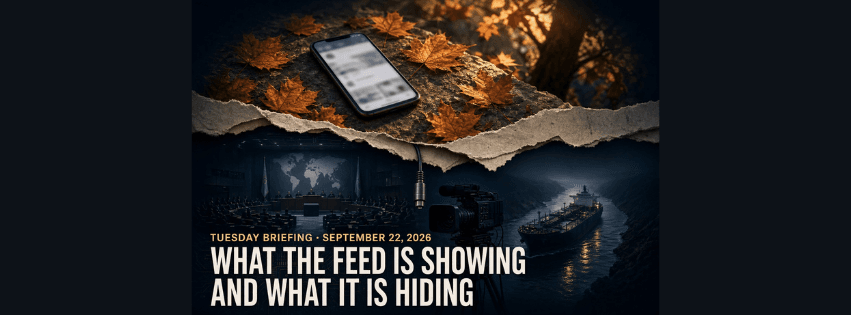
Tuesday opened on the first day of fall and a timeline full of pumpkins, tacos, and “Good Tuesday.” Underneath that, the same day is doing something harder: testing who still gets to narrate the world.
The United Nations General Assembly is in session. Leaders are in New York talking interdependence while the ground keeps producing the opposite. Another tanker was hit in the Strait of Hormuz. Russia hit Zaporizhzhia again. Ukraine says it damaged another Russian refinery. The Iran war is not a sidebar at UNGA. It is the weather system the speeches are walking through. Oil, insurance, shipping, food prices — that is the real agenda, whether the podium says so or not.
At the same hour, the fight is over the camera
Major networks paused pool video of the president after CNN, Politico, and MS NOW were barred from the White House. Those outlets sued. The White House answered with a 24/7 stream people are already searching as “Trump TV.”
That is not a media-gossip story. It is a distribution story.
When official video and independent video stop sharing a room, the public does not get one extra source. It gets two sealed rooms and a comment section in between. Search interest in voter registration sitting next to “Trump TV” is not an accident. People can feel the midterm clock and the information split at the same time.
The other war is compute
Washington floated an AI emergency hotline with China. Alibaba put out a new model and what it calls China’s most powerful AI chip. The UN secretary-general is telling the hall to treat AI as a threat class, not a product category.
That pairing matters. A hotline is what you build when you no longer trust the other side to slow down on their own. A chip announcement is what you ship when you assume they will not. We should not confuse “talks about safety” with a pause. The race is the policy.
Rubio saying the United States should hold at least two bases in Greenland belongs in the same frame. Minerals, routes, missiles, data cables — the map is being redrawn in hardware, not hashtags.
Institutions are trading, not resting
Paramount clearing a path toward Warner Bros. Discovery is the quieter headline that will last longer than a speech. Fewer owners, bigger pipes, more control over what a nation watches while governments argue about who is allowed in the briefing room.
Combine that with a White House stream and a network boycott and the question writes itself: who is the press when the venue and the feed are both contested?
Elsewhere the week is still a week. Typhoon Dujuan killed people in Japan and cut power to tens of thousands. India’s women took Asian Games cricket gold. NFL names are already owning a slice of X. None of that is smaller than geopolitics. It is the layer people actually live on while the podium talks about the system.
What this asks of anyone building
Fall content is easy. The harder read is the stack:
- War that still moves oil through a narrow strait.
- AI treated as both dinner-guest and emergency.
- News access becoming a permissioned product.
- Media consolidation running in parallel.
If we build culture, products, or markets in this climate, the job is not to pick a team color for the timeline. The job is to notice which layer we are standing on.
A first-day-of-fall post and a UNGA live blog can share a phone. They do not share a consequence.
The feed will keep serving autumn and Taco Tuesday. That is fine. Just do not let the season become the story while the real trades — cameras, chips, tankers, bases — clear without anyone asking who holds the rails.