
The Exemption Is Not the Innovation
The SEC issued a five-year Innovation Exemption for Tokenized Securities Venues — an analysis of permissioned AMM pools, rails vs. stories, and what building in crypto actually means when the fence goes up.
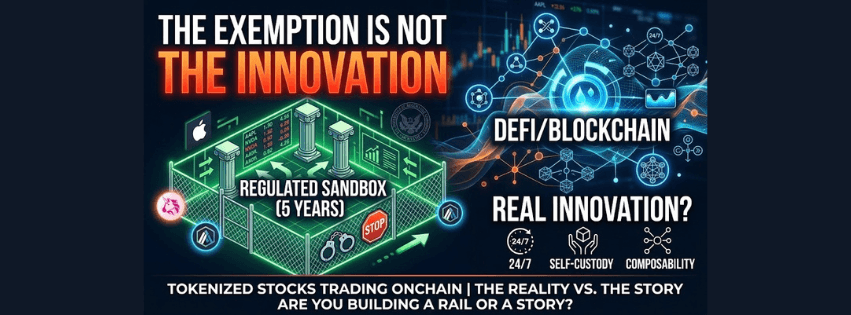
The SEC issued a five-year “Innovation Exemption” for Tokenized Securities Venues (TSVs). Onchain trading of certain tokenized NMS stocks is now possible in a narrow, permissioned box: U.S. person venues, permissioned AMM liquidity pools, no synthetics, same rights as the real share, issuer opt-out, volume and symbol caps, halt when the primary market halts. Liquidity providers get a matching dealer exemption. Congress failed to move the CLARITY Act. The Commission used existing authority instead. That is the news.
The market answered in the only language it trusts. UNI and ARB jumped on the order. They were the outliers. Not because the exemption blessed every AMM or every L2. Because those two sit closest to the shape of what the order actually describes: automated market makers and public-chain settlement rails that a permissioned venue could wrap compliance around. The tape did not crown a new culture. It priced infrastructure that already exists.
That should make anyone building in this space stop and ask a harder question than “did my bag pump.”
What is actually innovation now?
Innovation used to mean shipping something the old system could not do: 24/7 settlement, composability, self-custody, open liquidity. The exemption is not that. It is a controlled sandbox so the Commission can watch tokenized listed stock trade onchain and then write durable rules. Peirce said it plainly: this is not a DeFi exemption. It is a lab with walls.
So the interesting split is not “crypto vs TradFi.” It is tokenized reality vs tokenized story:
- Tokenized Reality: Real share, same votes, same dividends, issuer can say no, venue is a U.S. person, participants are permissioned.
- Tokenized Story: Synthetic exposure, permissionless pools, no issuer, no halt coordination, narrative volume.
The first is what the order allows. The second is what a lot of the last cycle called “innovation.” The market just told us which one it thinks the next five years might actually tolerate.
Why those tokens moved
Pumps that look like outliers usually have a boring reason.
UNI is the primitive the order keeps naming: AMM liquidity pools. ARB is a public, permissionless chain where a TSV could, in theory, run audited contracts while still gating who is allowed in the pool. The exemption does not make either protocol a registered venue. It makes their category suddenly relevant to people who write checks and file comments.
That is different from a meme catching a headline. One is proximity to a regulated product. The other is attention. Builders who cannot tell those apart will keep shipping the second and calling it the first.
What this means if you are building
Five years is long enough to waste and short enough to matter.
- If the work is permissionless DeFi, this order is not a green light. It is a map of where the fence is. Do not pretend a TSV wrapper is the same as an open pool.
- If the work is infrastructure — settlement, identity that still feels like crypto, halt logic, disclosure, audited AMMs, issuer notice flows — this is the window. The Commission asked for comment because it wants data. Venues that operate cleanly will write the next rule by existing.
- If the work is a token, ask whether it is a rail or a story. Rails got marked up yesterday. Stories still need a reason to exist after the press release fades.
The exemption expires. The question that does not: what are we actually building that still works when the temporary label comes off?
Innovation, these days, might just be the thing that can survive being watched.